How to Take Good Pictures of Your Art With a Camera for Your Online Portfolio
Every artist needs to keep visual records of their work—and whether you lot program on selling your art correct away or keeping it for years, you should always have up-to-date images prepare to share.
In this tutorial I'll explain exactly how to have corking photos of your artwork, and cover a few VERY basic steps in Photoshop that volition become your images ready for impress or uploading onto the internet.
Quick proclamation - EmptyEasel has created a quicker, easier way for artists to accept their own art website. Click here to learn more and get a simple fine art website of your ain!
All right, lets get started. . .
Subsequently the paint is completely dry, take your painting or cartoon outside on a sunny day. Natural outdoor lite is your best selection for lighting. If yous take a room with lots of windows or tons of vivid lighting, you lot can requite that a try also, but normally outside is best.
Notice a wall, or any place really, where you tin can prop upward your artwork so that it stands virtually perfectly upright.
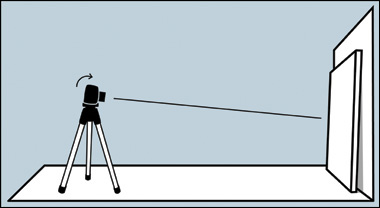
I'd suggest using a tripod with your digital photographic camera or telephone to make sure that you lot're taking perfectly steady shots.
No tripod? Don't sweat it, a box or small-scale table works just besides. Just brand certain to steady your phone or camera on SOMETHING to keep information technology from shaking.
When y'all take the photo, call up to tilt the camera slightly down (if necessary) to match the bending that the artwork is leaning—this will help minimize distortion of the original image.
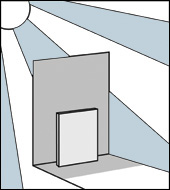 If it'southward extremely bright, find somewhere that gives little shade, otherwise put the painting in direct sunlight.
Afterwards on I've included a photograph which was taken on a actually brilliant summer twenty-four hour period in Idaho. I had to tone the lord's day'south intensity down just a chip then I placed my painting in a shadow.
Normally this won't exist the case, withal.
Many people accept trouble with their artwork looking slightly bubble-y, with each side bulging outwards. That's an result with the camera lens, but it'due south easily fixable.
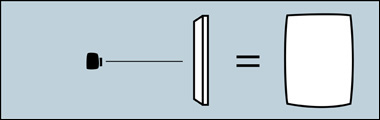
The solution is to utilise the "zoom" on your photographic camera, and and so back a step or two away from your art. This will create a more than natural corporeality of depth to the photograph and proceed those edges from ballooning unnaturally in your photo.
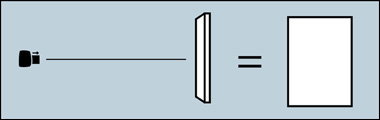
Be sure to fill up the viewfinder of the camera every bit much as possible and and then check to see that all the edges of your piece of work are parallel with the edges of the viewfinder. You'll want to peculiarly avoid these types of photographs:
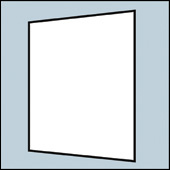
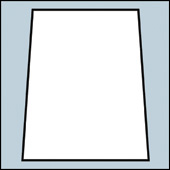
Both of those distortions come from the photographic camera non beingness expressionless center to the artwork.
Take several pictures because it won't ever be as easy to tell on the viewfinder whether or not there'due south any distortion. Once your images are up on your computer, yous'll be able to run into for sure which photograph is all-time.
When yous've uploaded the photos to your computer, bring them up in Photoshop or whichever photo-editing software you lot utilize. Although the next few steps will be based in Photoshop, you'll exist able to find something similar in whatever photo-editing program.
Here'south a pic of one of the pieces in my series of firefighting paintings from the local fire station. As you can encounter it'south photographed and in Photoshop to crop and correct.
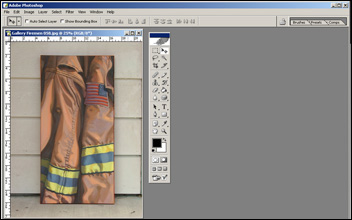
The first pace here is to correct the contrast. Although information technology'south a adequately good photo already, information technology'southward a footling dull compared to the existent painting.
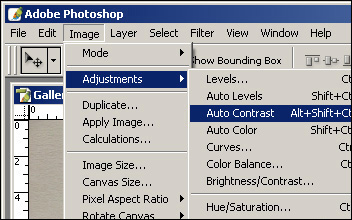
In Photoshop, select "Epitome," then "Adjustments," then click on "Machine Contrast."
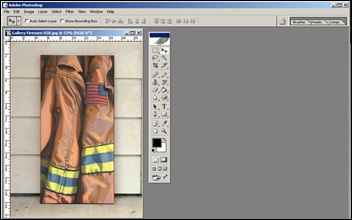
That did the trick. Since it was such a sunny day the colors turned out groovy without needing any actress work.
Now it'southward time to crop the artwork.
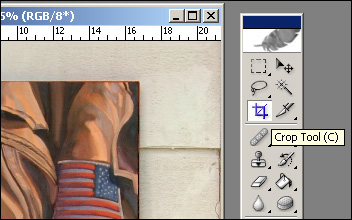
Select the "crop" tool from your tool bar and position information technology at one corner of the painting.
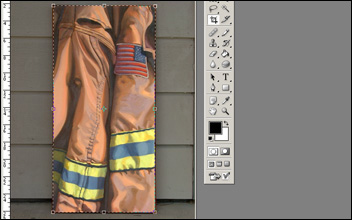
Click and drag the tool to create a box of dotted lines. Unclick at the reverse corner from where you started.
If you lined upwards the edges in the viewfinder while you took the photo, then you shouldn't have any bug at this point.
You can see that everything exterior the crop has been dimmed. You'll want to zoom in to make sure that you lot're cropping EVERYTHING out but the painting.
Even so, I usually crop but a TINY bit into the painting, which takes care of any slight distortions in the photograph.
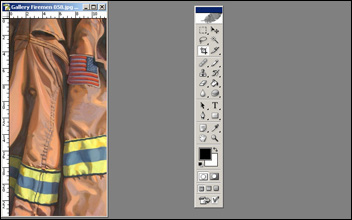
And at that place'south the finished digital paradigm. Relieve yours as a TIFF or PSD then that yous don't lose whatever file quality later on. Save it again as a JPG if you're planning on uploading it to the net.

Note: You may also be interested in EE's pace-by-step drawing guide for artists. Click below to learn more than!
This post may incorporate affiliate links.
howell-pricealith1951.blogspot.com
Source: https://emptyeasel.com/2007/01/19/how-to-photograph-your-artwork-for-a-portfolio-or-the-internet/
0 Response to "How to Take Good Pictures of Your Art With a Camera for Your Online Portfolio"
Post a Comment